Small-Space Christmas Trees: Compare the Whole Footprint
Choosing a Christmas tree for a compact room requires measuring more than just height. Use this practical four-part footprint worksheet to evaluate base hardware, lower branch spread, walking clearance, and off-season storage before you bring seasonal decor home.
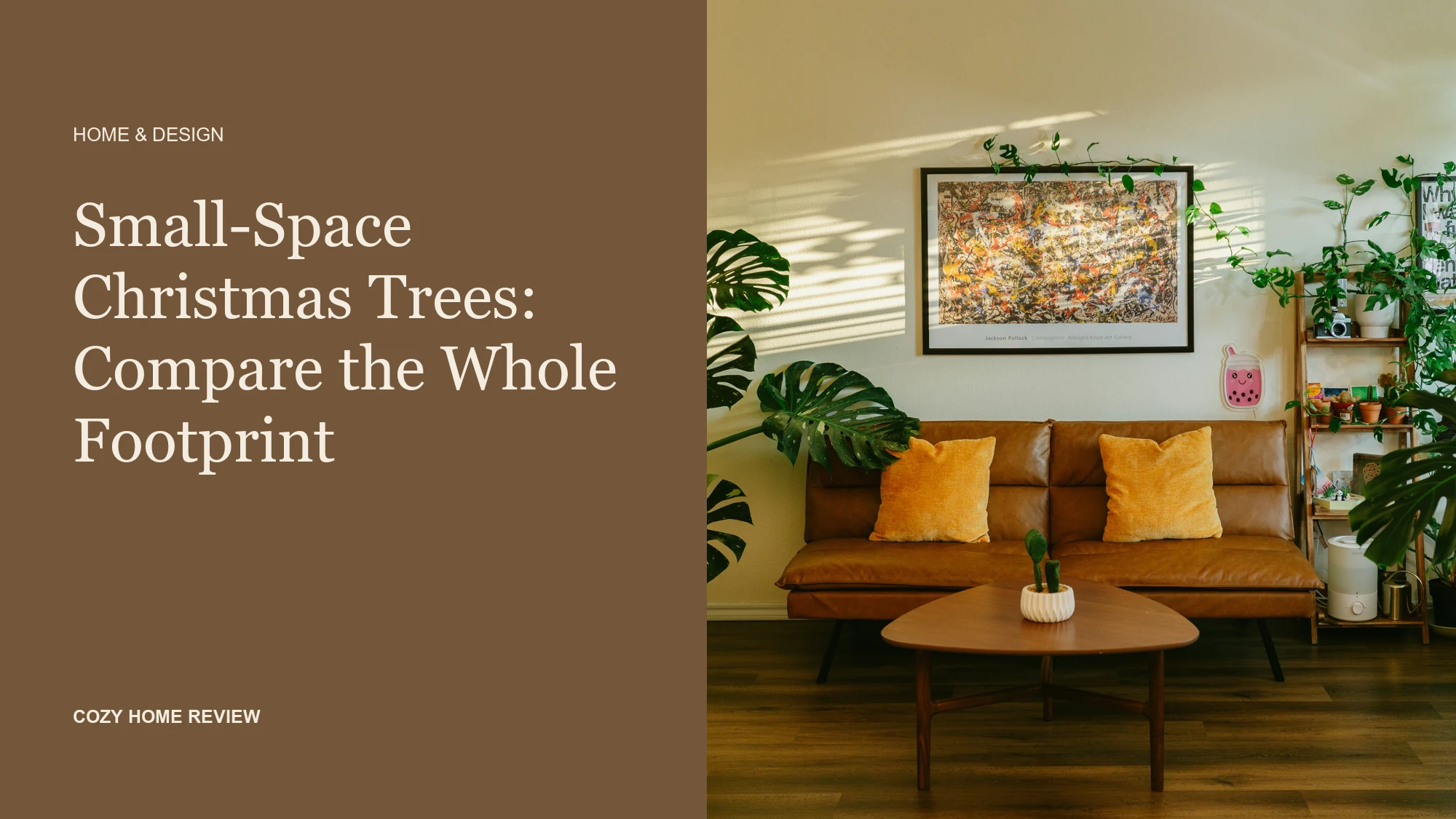
Fitting a holiday tree into a modest apartment or narrow living room requires looking beyond the height printed on the box. A display that looks compact on a retail floor can still block cabinet doors, catch on winter coats in a hallway, or overflow a hallway closet in January. Measuring the complete footprint—from the stand beneath the skirt to the off-season storage carton—keeps a small room livable throughout the season.
IKEA U.S. introduced its VINTERFINT holiday collection on November 4, 2026, with Scandinavian Folklore and Happy Carnival styles. The announcement offers seasonal design ideas, not independent evidence of what households should buy.
Why Height Is the Wrong First Measurement
Ceiling height is easy to eyeball, which is why most people start there. In a tight room, however, horizontal sprawl causes far more daily friction than vertical reach. A five-foot tree with a wide silhouette can claim more usable square footage than a seven-foot pencil profile.
When evaluating a corner or tabletop spot, treat the setup as a four-part spatial commitment: the mechanical base, the widest visual diameter, the surrounding traffic buffer, and the disassembled storage volume. Checking manufacturer labels for each of these dimensions prevents mid-December furniture rearranging.
The Four-Part Footprint Worksheet
Before browsing seasonal aisles, grab a tape measure and a roll of painter’s tape. Map out your candidate spot using the four criteria below, and bring those maximum numbers with you when reading box specifications.
| Footprint Zone | What to Measure at Home | Label & Setup Check | Hypothetical Studio Example |
|---|---|---|---|
| 1. Base & Stand | Flat floor or tabletop surface area away from floor vents and baseboard heaters. | Compare stand leg span against table depth or rug edges; check manufacturer assembly instructions for stability requirements. | A 14-inch square end table requires a tree base narrower than 12 inches so the stand sits flat inside the beveled edge. |
| 2. Branch Spread | Wall-to-furniture distance at the height where the lowest branches will sit. | Look for listed maximum diameter; note whether hinged branches can be shaped inward without exposing the center pole. | A corner between a sofa arm and a bookcase has 28 inches of width; target a tree listed at 22 to 24 inches wide. |
| 3. Access Buffer | Clearance for swinging doors, drawer pulls, dining chairs, and main walkways. | Add 18 to 24 inches of walking room outside the widest branch tips along active pathways. | Pulling out a dining chair requires 20 inches behind the table; the tree perimeter must stop before that line. |
| 4. Packed Volume | Interior height, width, and depth of your designated closet shelf or under-bed bin. | Check the retail box dimensions or ask how many sections the frame breaks down into for storage. | An under-bed clearance of 8 inches means a thick, single-piece tabletop tree will need closet shelf space instead. |
Evaluating Base vs. Branch Spread
The physical footprint on the floor and the visual footprint in the air rarely match. On floor-standing models, folding metal legs or wide plastic basins sometimes extend past the foliage on ultra-slim trees, creating a tripping hazard if the stand pokes into a hallway. Conversely, lush profiles often have compact stands hidden deep inside sweeping lower boughs that brush against adjacent upholstery.
If you are elevating a smaller tree on a credenza, plant stand, or bar cart, the base measurement becomes your primary constraint. Confirm that the entire span of the stand rests on a stable, level surface according to the manufacturer’s positioning guidelines, while the lower branches clear nearby lamps, framed art, or television screens.
Accounting for Ornament Overhang
Whether your style leans toward understated Scandinavian woodland motifs or bold, colorful carnival glass, ornaments alter a tree’s effective width. Pendulum ornaments, wide ribbons, and clip-on accents can add two to four inches to the perimeter of a small tree. If your chosen spot borders a high-traffic doorway between a kitchen and living area, leave an extra buffer beyond the bare branch measurements so passing sweaters do not sweep decorations onto the floor.
Planning for the January Breakdown
In a house with a basement or garage, an oversized cardboard box is a minor nuisance. In an apartment with a single coat closet, packed dimensions are just as critical as display dimensions. A dense, pre-shaped tabletop tree often comes in one solid piece; while small in December, it remains bulky in July because it cannot be broken down into flat layers.
Meanwhile, a taller, multi-section slim tree might disassemble into a narrow carton that slides easily behind hanging coats or beneath a bed frame. Before finalizing a choice, read the packaging details to see how the item ships and stores, and check the care label for recommended storage conditions so the materials hold their shape for next year.
Put Your Measurements to Work
Take five minutes tonight to mark your target floor or tabletop spot with painter’s tape, outlining both the maximum base size and the widest acceptable branch circle. Live with those tape lines on the floor for twenty-four hours—opening nearby drawers, pulling out chairs, and walking through the room with a laundry basket—then record the exact measurements in your phone before you shop.
Related reading
Sources and editorial notes
This is a research-based editorial guide, not a hands-on product test. Suggestions and hypothetical examples are our editorial interpretation; current prices, availability and terms should be checked with the provider.
Holiday Table Settings When Your Plates Do Not Match
Give every plate a place before you dress the table. This printable worksheet maps the same four plain plates and two patterned ones…
How to Decorate a Rental for the Holidays Without Hanging Anything
Give each holiday display a spot that leaves room for daily life. Use this placement worksheet to check your building rules and product…
How to Pack Christmas Decorations for Easy Setup Next Year
Choose one Christmas display that feels finished on its own, then pack for that setup first. A printable lid card lists what’s in…